What to do with a perma-project in the age of AI?

I'm the kind of person who hates to be bored. Recent years have taught me that boredom can be important, actually, and that "trying to avoid it" and "being afraid of it" are not all that dissimilar. But aside from the perspective of remembering to rest, and to creatively "breathe in" as well as "breathing out", my raison d'être in life is to engage with things, to explore things, and to make things.
From when I first started interacting with computers, I've loved making things with them - originally BASIC programs on my dad's old BBC Micro, then levels for computer games, then server plugins for Team Fortress 2, then proper applications once I fully grasped C++ at university, then pieces of digital artwork that allowed me to explore my personality, and even expanding out to music and DJ sets in recent years. I basically have to have some kind of project rolling on in the background, in one form or another; something that I can put work into on the commuter train, or that I can tinker away at in a cafe on a Sunday morning while I get myself some lunch. It's what keeps me going and makes me feel worthwhile, a way of working to put my stamp on the world, in some form. If a project falls apart, or gets boring, I just invent a new one. I simply have to have something that fills that niche.

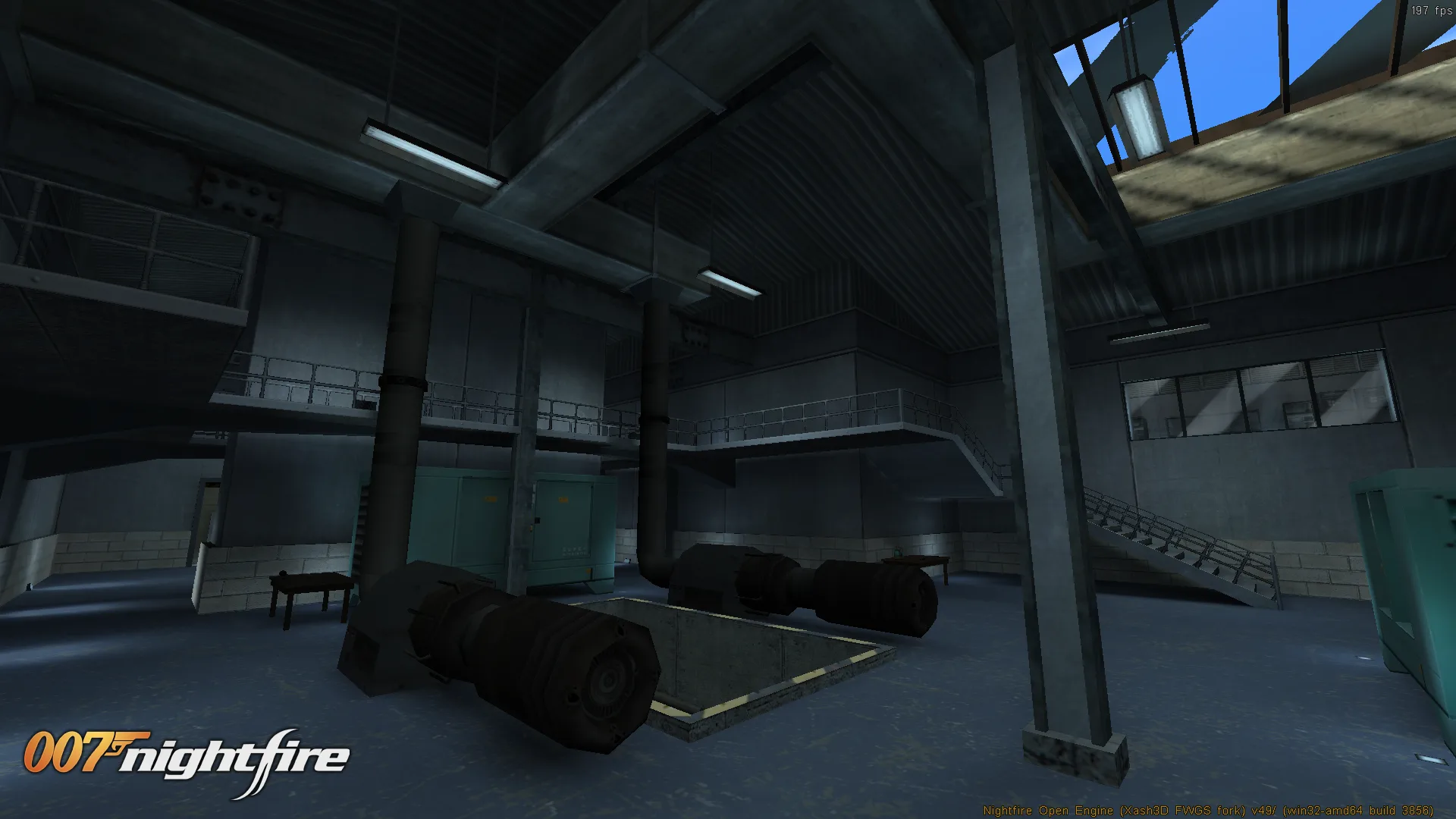
My current "main" project - meaning the one that is most persistently and reliably making progress - is Nightfire Open. This is a ground-up rebuild of the 2002 James Bond game 007 Nightfire for the PC. Nightfire was (not quite but almost) the first first-person shooter I ever played, and is solely responsible for getting me hooked on the genre. I'd bet that anyone who remembers playing this game has incredibly fond memories of it: the multiplayer mode was enormous amounts of fun, with a whole host of characters and weapons and gadgets that kept me, my friends and my brothers entertained for hours. The game was also given extra mystique, as if it needed it, by the fact that it was the only disc my friend's PS2 has trouble loading. We'd spend sometimes ten to fifteen minutes ejecting and re-inserting the disc, and holding the console at various angles, until it finally recognised the game and booted up, and we were away.
007 Nightfire was great fun on consoles, but not quite as polished on the PC. The PC version was made by Gearbox, and I think it's fair to say is probably the worst thing they've ever made. It was built on top of the original Half Life engine, and suffered from many limitations such as a lack of driving levels, poor enemy AI, peculiarly flat lighting (worse than even Half Life's was!), and regular crashes. It was my first experience of playing a shooter on the PC, and I loved it despite all of its flaws, but I was thirteen years old at the time.
Then, back in 2017, I was doing an internship with Epic Games that required me to take a ninety minute train journey twice a day, every day. On one of these journeys, thinking about ways in which I could use all of this slack time to my benefit, I started to have an idea: would it be possible for me to take the assets from the original Nightfire PC game and use them in the Half Life engine? Could I actually make a decent project out of that?
Fast-forward nine years, and it turns out that I did actually make a half-decent project out of it! It's been an on-and-off experience, as these things usually are for me - I'll work on something for a few weeks, burn out slightly, go do something else for a few more weeks, and then come back. Having worked in the software industry for a decade now, I'm also much better at breaking tasks down and setting measurable and achievable goals than I once was. Progress is slow, as it always is for something that cannot be my full-time job, but there is progress, and it's satisfying.
However, now that we're in the age of AI development tools, the backdrop to my projects has changed rather dramatically. I'm of the opinion that I don't want to use AI at all for any of my creative projects - the whole point of these things is that they're something I can do, both to occupy myself at times where I'd otherwise be bored, and to produce something that can count as making my mark on the world. Why would I delegate that to a machine? It would take all the fun out of the project, and arguably replace my work with a machine-created "product" that may or may not be my own, depending on how you choose to define what authorship means.
All this being said, part of my motivation to create things is certainly to, well, have created something. I know very well what it's like to do programming, or level design or whatever else, without ever properly finishing anything you start. You only have to look at my TF2 maps repository to see how many TF2 maps I have not in fact finished over the years.

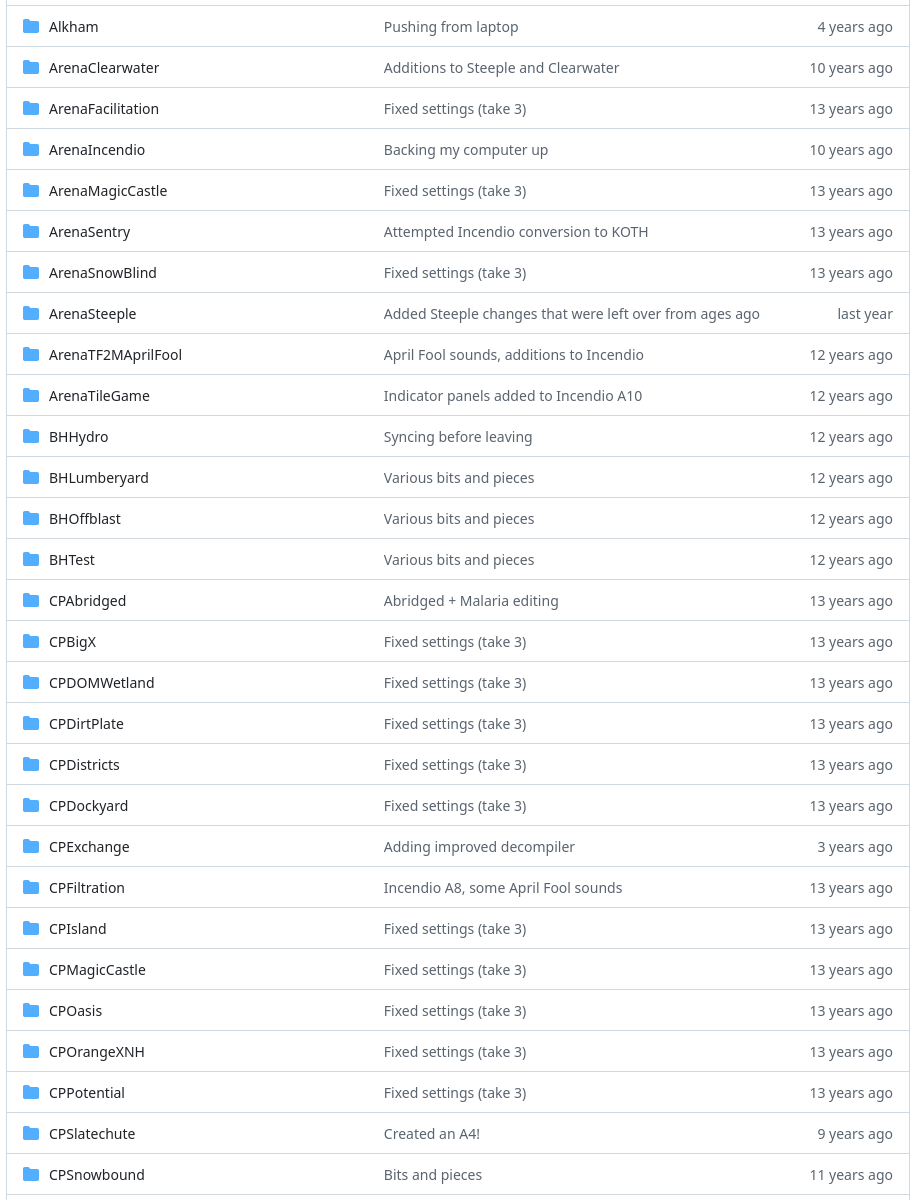
Each one of these, at some point in time, was the most important thing I was working on. And there are many more than this.
It's great to do something for the love of doing it! But I've found that if that's all you ever do, you never have anything to show for it, and you never get the feedback for your soul that comes from sharing what you've made with other people who like it. These elements are just as important to me now as the rest of the process, even though I've been historically bad at valuing them (because it's always easier to drop one project and start something new than it is to persist with something until it's finished).
This is a round-about way of admitting that, yes, I have weighed up the pros and cons of using AI tools to accelerate what I'm doing. Wouldn't it be a good thing to actually finish something, or at least hit some milestones a bit more quickly? I've spent the last year alone trying to overhaul the game's UI system, all by myself. What trade-offs would I be willing to accept in order to make more progress?
To be able to answer that question truthfully, I've had to think deeply about why I do what I do (and this post was born out of my attempts to do that). The short answer is: I still don't really want to use AI to create anything, at all, because my own authorship over any project that I undertake as a hobby is more important to me than the speed at which it's completed. But it turns out the main factor that troubles me is less about authorship anyway, and more about the cultural context in which I'm now working.
There is a Nightfire reverse-engineering community that exists, which I was invited to be a part of soon after I started on my PC game rebuild. They're more focused on working out how to decompile, and access the assets of, the console version of the game, and have made an impressive amount of progress. Lately, of course, AI agents have entered the equation, and some people have started coming out with really quite impressive reverse-engineered demos, in very little time indeed.
This hasn't changed my approach to how I want to develop my own project, but it has definitely negatively impacted my feelings around why, or whether, I do want to continue. Given that it's now become so accessible to spin up an AI agent, let it munch on some binaries for a while, and spit out some reverse-engineered code that's largely functional, how valuable would my own project be even if I did manage to get it to a fun and playable end state? Part of the allure of a project like this - a small part, but a part nonetheless - is the prestige of having put all those hours in, and driven the project from start to finish, to turn it into something that you think and hope people will enjoy. Others can now type a few commands, and with a fraction of the effort come up with something comparable to what you've spent a significant portion of your free time on over the last decade.
This is causing me to re-evaluate not just my approach to developing Nightfire Open, but more fundamentally, whether it's worth my time developing it at all. I would absolutely love to see it through to being a finished product, but if that takes me another ten years, would I just be finishing a marathon after the point where everyone else has crossed the finish line, and the spectators have all packed up and gone home?
The decision is put into even sharper focus by the recognition that I always have more projects that I'd like to do than I have time to do them. Lately, I'd love to be able to spend more time doing music production, because I feel like it's a much more direct way to present some of my emotions and artistic visions to people who might be interested. I currently don't spend very much time in Ableton, because I know I have momentum on the Nightfire Open project and have sunk a lot of time into it. If I keep jumping off to do other things, it's going to take even longer to complete it. I worry that it'll end up like the Left 4 Dead 2 campaign that I started making in 2010, and which has been in limbo for so long that I'm not sure how many people would be around to play it now, even if I did release it.
So the decision I feel I'm facing is not whether to use AI in my projects. It's really become about how to be an "analogue developer" in a digital landscape; or to put it another way, whether my options have now become "use AI to bring something shallow to completion", versus "use my own skills to build something meaningful but irrelevant".
I am very aware that I first had ideas for Nightfire Open in 2017, and in a few months' time it'll be 2027. Would it be all that bad to put it to bed, if it meant I could choose a new project entirely? One where I could both continue to be an "analogue" developer or creator, and also have an impact in a reasonable time frame?
Or could I get other people to join in and help push Nightfire Open forward? Would that just make it into a second job? Would anyone play it anyway?
I'm not sure whether I know the answers to any of these questions yet, but I might need to soon.